DISABILITY
WHAT IS THE AMERICANS WITH DISABILITIES ACT (ADA)?
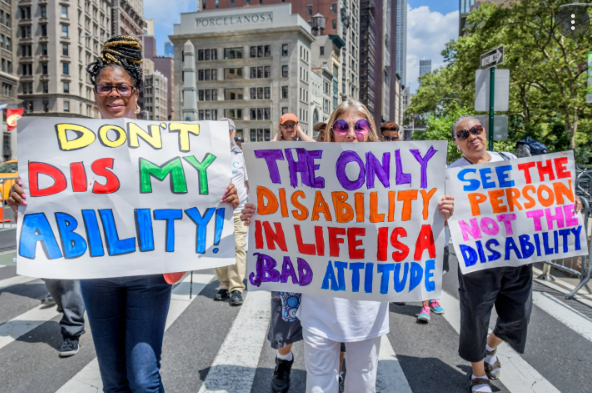
The Americans with Disabilities Act (ADA) was passed on July 26, 1990. The purpose of the ADA is to combat the discrimination against persons with physical or mental disabilities. It was established to give people with disabilities equal opportunity in such areas as employment, public accommodations, transportation, state and local government services, and telecommunications.
Title I of the ADA prohibits discrimination by employers against qualified individuals with disabilities. It prohibits discrimination throughout the entire employment process, including with regards to job applications, the hiring and firing process, compensation, job training, and all other terms, conditions, and privileges of employment.
The ADA is broader in scope than the Rehabilitation Act of 1973, which only covers programs receiving federal funding and the federal government itself. Title II of the ADA defines "disability" in the same way as the Rehabilitation Act — as a physical or mental impairment that substantially limits one or more major life activities.
WHAT IS PARTIAL DISABILITY?
Partial disability is a medical condition where a person suffers from an injury or illness that restricts them from being able to perform their job duties at full capacity, but doesn't prevent them from working altogether. An injured construction worker, for example, who can no longer perform all of their physical duties but can still work in a supervisory capacity may be considered partially disabled.
In order to qualify for partial disability benefits, a person must prove that their injury is related to or caused by performing their work functions. Common partial disabilities include chronic pain conditions, carpal tunnel syndrome, back and neck injuries, heart attacks, diabetes, and hearing or vision loss.
WHAT IS TOTAL DISABILITY?
A total disability is a condition that prevents a person from performing any work at all. It may result from loss of limbs, hands, or eyes, or from an occupational disease such as COPD, lung disease, multiple sclerosis, Parkinson's disease, or mesothelioma.
Total disability also refers to a condition that substantially limits one or more of a person's major life activities, including:
- Breathing;
- Speaking;
- Walking;
- Learning;
- Working; and
- Eating.
Total disability may be temporary or permanent. For example, a broken leg that heals completely after surgery and physical therapy would be considered a temporary total disability. Permanent total disability results from conditions such as paralysis or the permanent loss of a limb.
WHAT IS THE DIFFERENCE BETWEEN TOTAL VS. PARTIAL DISABILITY?
The primary difference between total and partial disability is whether the disabled person can return to their job. A person with a total disability is unable to perform any work, while a person with a partial disability can still perform some work functions. In order to receive total disability benefits, a person must prove that they are unable to work for at least one year.
WHAT IS "PERMANENT DISABILITY"?
A permanent disability is one that a person is expected to suffer from for the rest of their lives. Total permanent disabilities include conditions such as the loss of an arm or leg, paralysis, and severe psychological injuries. Partial permanent disabilities are conditions where the person is eventually able to return to work, such as a broken leg that heals completely.
HOW DO I FILE FOR A TOTAL OR PARTIAL DISABILITY CLAIM?
Filing a disability claim will depend on the specific federal and state laws governing your situation. Generally, you may file a claim through your insurance company, through your state's workers' compensation system, or through the Social Security Administration (SSA). For SSA claims, visit the SSA website at www.ssa.gov for information on how to apply.
CAN I APPLY FOR SOCIAL SECURITY DISABILITY IF I HAVE ALREADY RECEIVED DISABILITY BENEFITS THROUGH WORKERS COMPENSATION?
You may be eligible to receive both workers' compensation and Social Security disability benefits at the same time. However, there is a limit to the combined amount you can receive. The combined amount of workers' compensation and Social Security benefits generally cannot exceed 80% of your average current earnings. Your Social Security benefit may be reduced until you reach retirement age.
WHAT DOES "EMPLOYMENT" MEAN UNDER THE ADA?
Title I of the ADA prohibits discrimination against disabled individuals throughout the entire employment process, including:
- Job applications;
- Interviews;
- Testing;
- Job training;
- Job offers;
- Work assignments;
- Performance evaluations; and
- Terminations and promotions.
WHAT TYPES OF PUBLIC ACCOMMODATIONS DOES THE ADA COVER?
Title III of the ADA requires that public places be accessible to people with disabilities. This includes requirements such as handrails, wheelchair ramps, and accommodations for service animals. It also requires the provision of devices to assist people with vision, speech, and hearing disabilities.
Public accommodations covered by the ADA include:
- Restaurants and bars;
- Hotels and motels;
- Retail stores;
- Sidewalks and pedestrian crosswalks;
- Restrooms;
- Schools and universities;
- Office buildings; and
- Movie theaters.
WHAT ARE SOME ADA REQUIREMENTS FOR TRANSPORTATION?
The Department of Transportation (DOT) has rules requiring that public transportation be accessible to people with disabilities. These rules include:
- Vehicles must be handicap accessible;
- Disabled passengers cannot be charged extra for accessible services;
- Disabled passengers cannot be required to travel with an attendant; and
- Disabled passengers cannot be harassed or discriminated against.
WHAT ARE SOME LAWS THAT COVER HOUSING DISCRIMINATION?
Several federal laws protect disabled individuals from housing discrimination, including:
- The Fair Housing Act (Title VIII of the Civil Rights Act of 1968): Prohibits discrimination in the sale, rental, and financing of housing on the basis of disability, among other protected characteristics;
- Title II of the ADA: Prohibits state and local governments from discriminating in programs, services, and activities, which can include housing programs; and
- The Architectural Barriers Act (ABA): Requires that facilities designed, built, or altered with federal funds be accessible to people with disabilities.
State laws may also provide additional protections for disabled individuals in housing. The specific protections will vary by state.
DO I NEED TO HIRE A SPECIAL ATTORNEY FOR A DISABILITY DISCRIMINATION CASE?
A disability discrimination attorney can help you understand your rights under federal and state law, gather evidence to support your claim, and represent you in court if necessary.
Call our office today at (833) 388-7044 or complete the convenient online contact form to set up a consultation.